
SOLID Principles in C#: Beginner-Friendly Guide to Clean Code
Learn SOLID principles in C# with easy-to-understand examples. Master SRP, OCP, LSP, ISP, and DIP to write clean, maintainable, and scalable code.
Have you ever started a brand new software project where everything felt perfectly organized? You add a new feature, and it works seamlessly. You add another, and it still performs flawlessly. The codebase is incredibly fast, clean, and you feel entirely in control of the application architecture. Then, six months go by. The application scales. You need to make one ostensibly small update to the login mechanism. You open the relevant file, modify a few lines of logic, test the application, and suddenly three completely unrelated features break in production.
What just happened?
This scenario is what software developers refer to as technical debt, tightly coupled architecture, or simply spaghetti code. It happens to almost every developer working in the industry. But what if there was an established methodology to structure your applications so that adding new features does not inadvertently destroy existing ones? What if you could build software that is genuinely a joy to read, test, and maintain over the long term?
That is exactly where the SOLID principles come into the picture. Introduced and popularized by software engineer Robert C. Martin, SOLID is an acronym that represents five foundational software design principles. These guidelines act as guardrails, helping developers create applications that are robust, highly testable, and incredibly flexible when requirements inevitably change. While they form the absolute backbone of modern Object-Oriented Programming, beginners often find them intimidating or overly theoretical when first encountering them.
In this comprehensive guide, we are going to break down each of the five SOLID principles using relatable real world analogies and highly practical C# examples. By the end of this article, you will understand exactly how to apply these rules to your own ASP.NET Core applications, allowing you to sidestep the spaghetti code trap forever and build software that stands the test of time.
S: The Single Responsibility Principle (SRP)
The first letter of the acronym stands for the Single Responsibility Principle. The core definition dictates that a class should have one, and only one, reason to change.
Imagine you are dining out at a brand new local restaurant. You walk through the front door, and a single person greets you at the host stand. This exact same person then takes your order, runs into the kitchen to cook your meal, brings the food to your table, calculates your check, and eventually washes your dishes. That operational model is completely chaotic. If that single employee gets sick or overwhelmed, the entire restaurant shuts down completely. Successful restaurants divide responsibilities efficiently. The host seats the guests, the waiter takes the orders, the chef cooks the food, and the dishwasher handles the cleaning.
In software engineering, the Single Responsibility Principle states that a class should do exactly one thing. When a single class takes on too many disparate responsibilities, it becomes incredibly fragile and very difficult to maintain. If you need to change how the application logs errors, you might accidentally break the user registration logic because they exist in the exact same file.
Let us examine a very common mistake pattern written in C#.
public class CodeToClarityUserService
{
    public void RegisterUser(string username, string password)
    {
        // Responsibility 1: Validate input
        if (string.IsNullOrEmpty(username))
        {
            throw new ArgumentException("Username is completely required for registration");
        }

        // Responsibility 2: Save user to the database
        Console.WriteLine($"Initiating database connection and saving {username}.");

        // Responsibility 3: Send a welcome email validation
        Console.WriteLine($"Formatting and sending a welcome email to {username}.");
    }
}
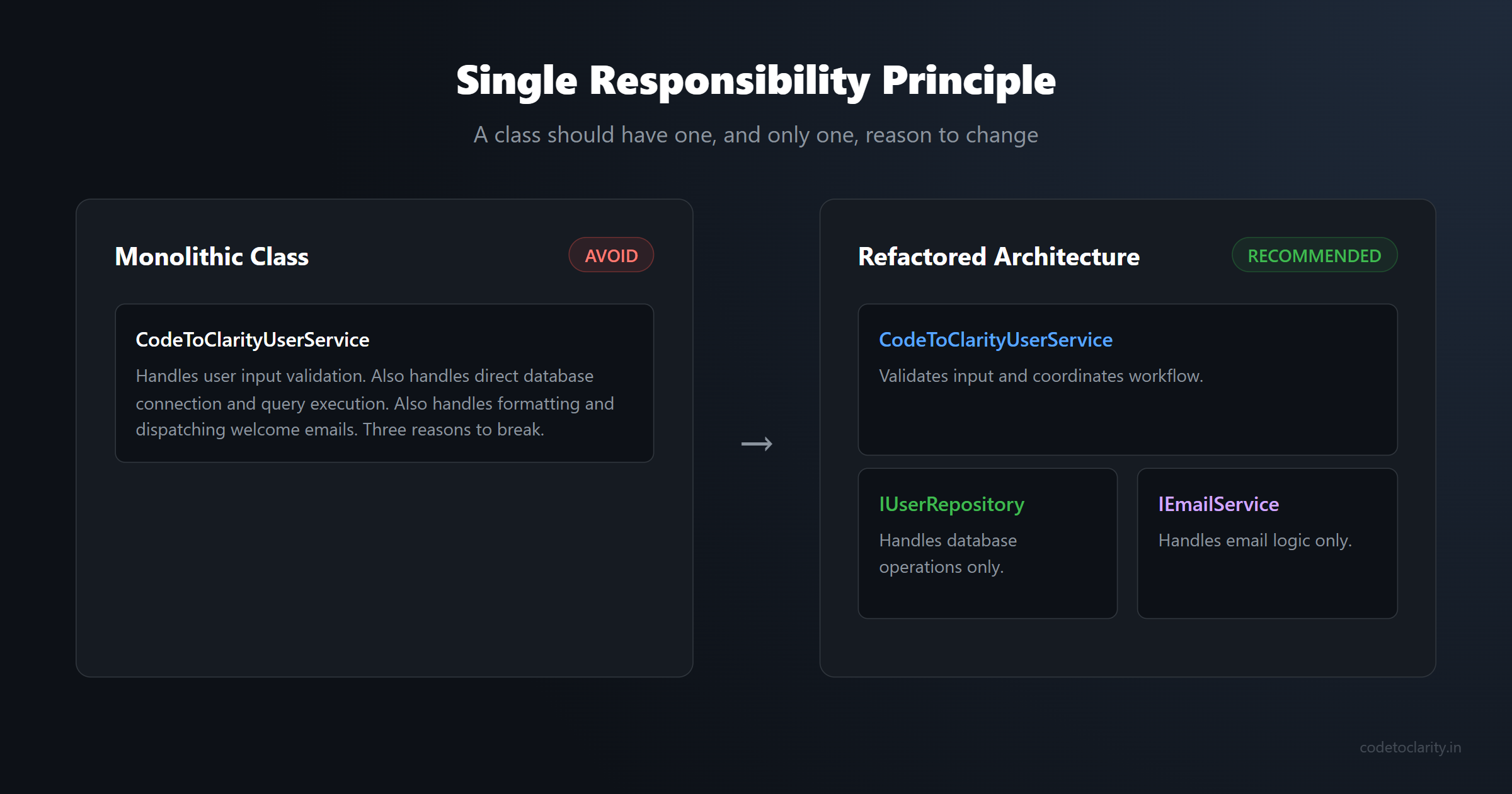
Why is the above code highly problematic? The CodeToClarityUserService handles input validation, direct database operations, and email notifications all at once. Consequently, it has three distinct reasons to change. If your team decides to swap out the email provider from a local SMTP server to a cloud-based service, you are forced to open and modify the user registration service file.
We can systematically refactor this code to follow SRP. We will split the responsibilities into focused, dedicated classes.
public class CodeToClarityUserService
{
    private readonly IEmailService _emailService;
    private readonly IUserRepository _userRepository;

    public CodeToClarityUserService(IEmailService emailService, IUserRepository userRepository)
    {
        _emailService = emailService;
        _userRepository = userRepository;
    }

    public void RegisterUser(string username, string password)
    {
        if (string.IsNullOrEmpty(username))
        {
            throw new ArgumentException("Username is required");
        }

        _userRepository.SaveUser(username, password);
        _emailService.SendWelcomeEmail(username);
    }
}
Now, the user service only coordinates the high level registration workflow. If the underlying email delivery logic changes, the CodeToClarityUserService remains blissfully untouched. Your code immediately becomes much easier to test, straightforward to read, and remarkably simple to maintain as your team grows.
O: The Open/Closed Principle (OCP)
The second principle is the Open/Closed Principle. The definition states that software entities like classes, modules, and functions should be open for extension, but completely closed for modification.
Think about a standard video game console connected to your television. When you want to play a brand new game, you do not unscrew the plastic console case, manually solder a new silicon chip onto the motherboard, and write custom firmware to boot it up. That would be absurd. You simply insert a new game disc or download a new digital title. The physical console itself is completely closed for internal modification, but it remains fully open for functional extension via game cartridges.
In C# development, if you want to add new functionality to a class, you should ideally not have to rewrite or modify the existing, heavily tested code. Modifying existing code heavily increases the risk of introducing catastrophic regression bugs into features that already functioned perfectly in production.
Consider a class that calculates product discounts for various distinct types of customers.
public class CodeToClarityDiscountCalculator
{
    public double CalculateDiscount(string customerType, double invoiceAmount)
    {
        if (customerType == "Regular")
        {
            return invoiceAmount * 0.05;
        }
        else if (customerType == "Premium")
        {
            return invoiceAmount * 0.10;
        }
        else if (customerType == "VIPLevelCustomer")
        {
            return invoiceAmount * 0.20;
        }

        return 0;
    }
}
Every single time your enthusiastic marketing team introduces a new promotional customer tier, you are forced to open this specific file, inject yet another conditional statement, and recompile the entire module. This blatantly violates the Open/Closed Principle.
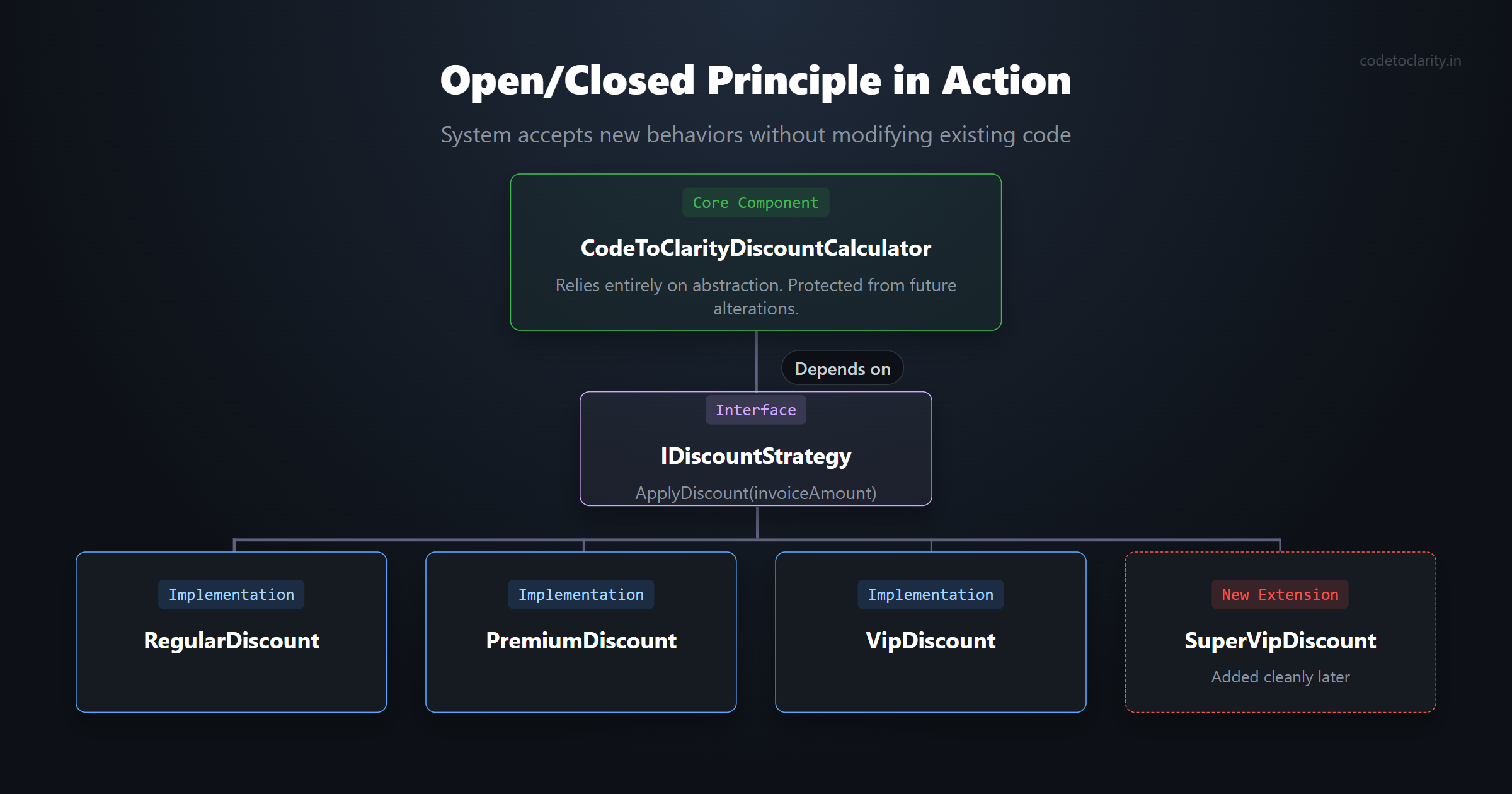
We can elegantly fix this architectural flaw by utilizing polymorphism and defining an interface. We establish a common blueprint for discount strategies and pass the correct strategy directly into the calculator. This is a very common implementation of the Strategy Design Pattern.
public interface IDiscountStrategy
{
    double ApplyDiscount(double invoiceAmount);
}

public class RegularDiscount : IDiscountStrategy
{
    public double ApplyDiscount(double invoiceAmount) => invoiceAmount * 0.05;
}

public class PremiumDiscount : IDiscountStrategy
{
    public double ApplyDiscount(double invoiceAmount) => invoiceAmount * 0.10;
}

public class VipDiscount : IDiscountStrategy
{
    public double ApplyDiscount(double invoiceAmount) => invoiceAmount * 0.20;
}

public class CodeToClarityDiscountCalculator
{
    public double CalculateDiscount(IDiscountStrategy specificStrategy, double invoiceAmount)
    {
        return specificStrategy.ApplyDiscount(invoiceAmount);
    }
}
Now, when a brand new "Enterprise Super VIP" promotional tier is ultimately added next quarter, you simply generate a brand new EnterpriseSuperVipDiscount class. The main CodeToClarityDiscountCalculator code remains entirely untouched. This robust approach keeps your existing legacy features thoroughly protected from accidental code regressions.
L: The Liskov Substitution Principle (LSP)
The Liskov Substitution Principle often sounds highly academic and mathematical. It was formulated by computer scientist Barbara Liskov, and it states that derived or child classes must be fully substitutable for their base parent classes without altering the overall correctness of the program.
The practical meaning of this principle is actually very straightforward. If you have a base parent class and a resulting child class, you must be able to swap them out seamlessly within the application loop. The child class must faithfully honor the implicit contract established by the parent.
Imagine you order a heavy delivery vehicle through a logistics application to move your refrigerator. The app confirms a valid vehicle will arrive. You reasonably expect a sturdy car, a spacious van, or perhaps a pickup truck. If a worker on a small bicycle arrives to transport your massive refrigerator, you would be rightfully disappointed. The bicycle is technically classified as a vehicle, but it completely fails to fulfill the basic expectations of the vehicle contract in this specific context.
In your codebase, painful violations of LSP frequently manifest as classes throwing a NotImplementedException or producing highly unexpected behaviors in child classes. Let us examine a payment processing situation.
public abstract class CodeToClarityPaymentProcessor
{
    public abstract void ProcessIncomingPayment(double invoiceAmount);
    public abstract void ProcessPaymentRefund(double invoiceAmount);
}

public class CreditCardProcessor : CodeToClarityPaymentProcessor
{
    public override void ProcessIncomingPayment(double invoiceAmount) { /* Secure payment logic */ }
    public override void ProcessPaymentRefund(double invoiceAmount) { /* Standard refund logic */ }
}

public class CryptocurrencyProcessor : CodeToClarityPaymentProcessor
{
    public override void ProcessIncomingPayment(double invoiceAmount) { /* Blockchain transfer logic */ }

    public override void ProcessPaymentRefund(double invoiceAmount)
    {
        throw new NotImplementedException("Cryptocurrency blockchain payments cannot be reversed or refunded directly.");
    }
}
If another administrative part of your backend loops through an array of CodeToClarityPaymentProcessor generic instances and invokes ProcessPaymentRefund() on all of them, the entire application will abruptly crash the moment it iterates onto the CryptocurrencyProcessor. The child class utterly broke the rules of the parent class.
To rectify this issue, we must rethink our base abstractions. Not all payment methods universally support straightforward refunds. We need to selectively separate these distinct capabilities into more granular interfaces.
public interface IProcessPayment
{
    void ProcessIncomingPayment(double invoiceAmount);
}

public interface IRefundPayment
{
    void ProcessPaymentRefund(double invoiceAmount);
}

public class CreditCardProcessor : IProcessPayment, IRefundPayment
{
    public void ProcessIncomingPayment(double invoiceAmount) { /* Payment logic */ }
    public void ProcessPaymentRefund(double invoiceAmount) { /* Refund logic */ }
}

public class CryptocurrencyProcessor : IProcessPayment
{
    public void ProcessIncomingPayment(double invoiceAmount) { /* Logic */ }
    // No refund capability implemented, safely avoiding the runtime exception risk.
}
By ensuring that subclasses strictly adhere to reliable expected behaviors, you definitively guarantee that your application will not randomly crash when utilizing class abstraction. If you want to dive deeper into proper C# interface design directly from the creators of the language, checking out the official Microsoft documentation on interface design is highly recommended.
I: The Interface Segregation Principle (ISP)
The Interface Segregation Principle states that clients should not be forced to depend upon interfaces that they do not actually use.
Have you ever attempted to operate an overwhelmingly complex remote control designed for a premium home theater setup? It features over a hundred tiny buttons, yet you really only ever press the red power switch, the volume rocker, and the channel selection arrows. Because the heavy remote attempts to serve absolutely every imaginable system function, it becomes confusing, bloated, and incredibly frustrating to operate in the dark. The Interface Segregation Principle strictly advises against creating massive, kitchen sink style interfaces in software engineering.
When a large interface contains numerous methods that a specific class realistically does not need, that class is unfairly burdened with writing empty dummy implementations or inserting exception throwing methods. This creates substantial noise and confusion within the repository.
Consider a large interface initially designed for all general employees in a development company.
public interface ICompanyWorker
{
    void WriteApplicationCode();
    void TestSoftwareQuality();
    void ManageClientProject();
    void DisburseEmployeeSalaries();
}
If we need to formally create a JuniorDeveloper class, they will be forcefully required to implement methods they have absolutely no business handling.
public class JuniorDeveloper : ICompanyWorker
{
    public void WriteApplicationCode() { /* standard coding logic */ }
    public void TestSoftwareQuality() { /* basic unit testing logic */ }

    public void ManageClientProject()
    {
        throw new NotImplementedException("I am solely a developer, not a certified project manager.");
    }

    public void DisburseEmployeeSalaries()
    {
        throw new NotImplementedException("I categorically do not have secure payroll access.");
    }
}
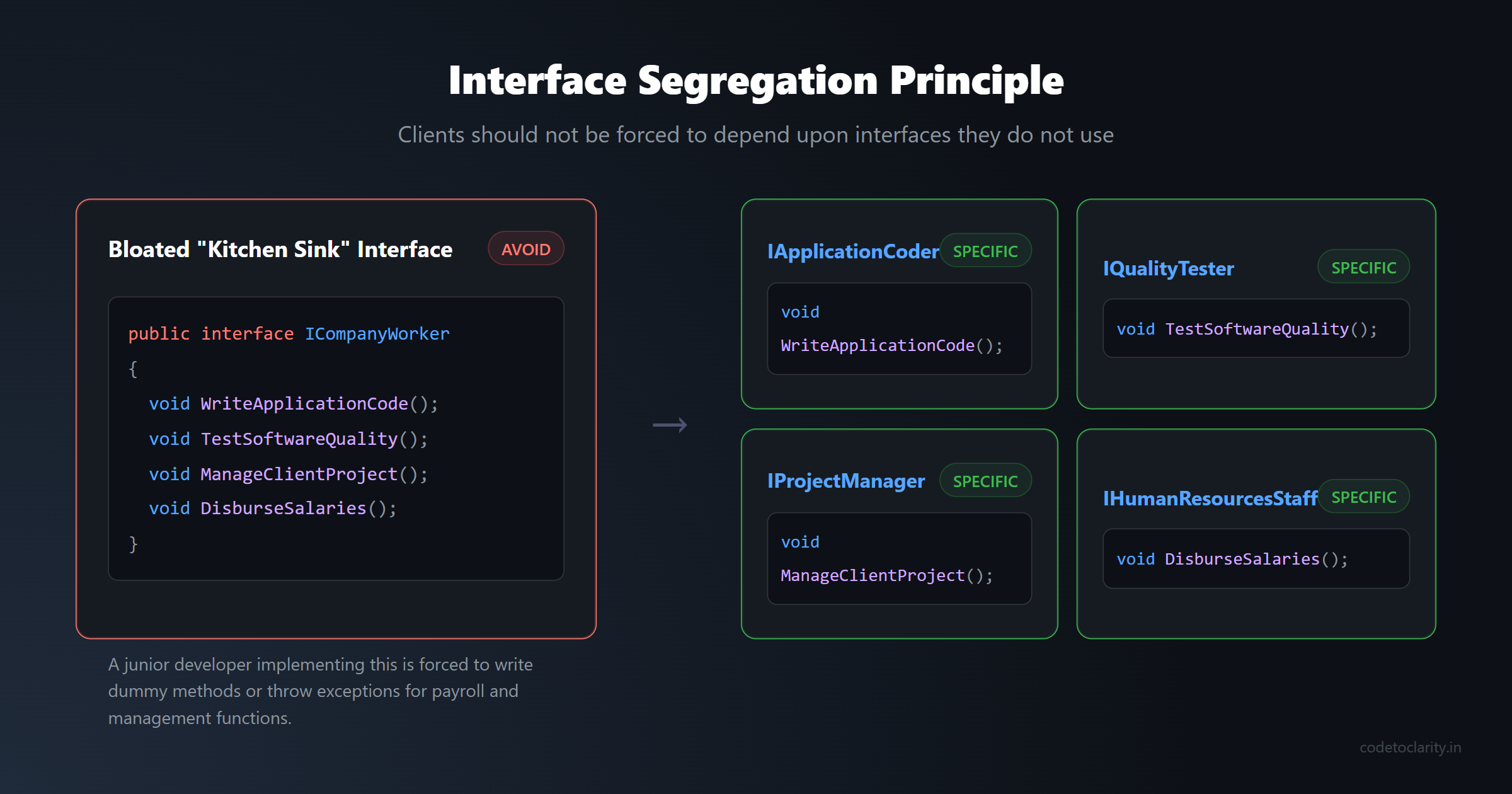
This resulting design is incredibly messy and frustrating to work with. The clear solution is to slice the oversized interface into much smaller, highly modular, and fundamentally client specific interfaces.
public interface IApplicationCoder
{
    void WriteApplicationCode();
}

public interface IQualityTester
{
    void TestSoftwareQuality();
}

public interface IProjectManager
{
    void ManageClientProject();
}

public interface IHumanResourcesStaff
{
    void DisburseEmployeeSalaries();
}
Following this architectural adjustment, the JuniorDeveloper class can cleanly and securely implement solely IApplicationCoder and IQualityTester. The Human Resources payroll system components only need to depend on the IHumanResourcesStaff interface. Your interfaces have successfully transformed into tiny, composable building blocks that precisely articulate the true capabilities of the implementing classes. Small interfaces also prominently increase your ability to successfully mock critical dependencies securely during robust unit testing cycles.
D: The Dependency Inversion Principle (DIP)
The final key principle is the Dependency Inversion Principle. The formal definition explains that high level modules should not depend critically on low level modules. Instead, both tiers should depend comfortably on abstractions. Furthermore, abstractions should absolutely not depend on granular details. Details should universally depend on abstractions.
Let us think briefly about standard utility electricity in your residential household. When you purchase a reading lamp, you inherently plug it into a standardized, universally accepted wall socket. You certainly do not rip out the drywall, strip the copper wires from the wall studs, and permanently solder them sequentially to the lamp circuitry. The wall socket reliably serves as a safe abstraction. Because of this extremely effective abstraction layer, you can easily unplug the small lamp tomorrow and confidently plug in a massive television into the exact same outlet without causing a fire. The municipal power grid entirely does not care what specific commercial device is consuming the provided electricity.
In poorly designed C# codebases, high level classes often depend directly and tightly on other concrete, highly specific classes. This heavily hardwires them natively together, making the broader system incredibly difficult to modularly test and frighteningly slow to adapt to changing external requirements.
Let us realistically look at a highly dangerous hardwired dependency architecture.
public class TextMessageNotificationSender
{
    public void SendAlert(string alertPayload) { /* specific SMS API integration logic */ }
}

public class CodeToClarityApplicationService
{
    private readonly TextMessageNotificationSender _messageSender;

    public CodeToClarityApplicationService()
    {
        // Dangerous hardcoded dependency. We officially soldered the lamp totally directly to the wall.
        _messageSender = new TextMessageNotificationSender();
    }

    public void SecurelyNotifyUser(string alertPayload)
    {
        _messageSender.SendAlert(alertPayload);
    }
}
What aggressively happens if our enterprise application suddenly requires the ability to dispatch email notifications instead of SMS messages next month? We would essentially have to completely rewrite the core CodeToClarityApplicationService logic to accommodate this basic request. We can beautifully solve this significant issue by preemptively introducing an abstraction layer and cleanly injecting the actual required dependency into the class lifecycle.
public interface INotificationTransmitter
{
    void SendAlert(string alertPayload);
}

public class EmailNotificationSender : INotificationTransmitter
{
    public void SendAlert(string alertPayload) { /* Enterprise email server logic */ }
}

public class TextMessageNotificationSender : INotificationTransmitter
{
    public void SendAlert(string alertPayload) { /* Mobile SMS gateway logic */ }
}

public class CodeToClarityApplicationService
{
    private readonly INotificationTransmitter _messageSender;

    // The preferred dependency is dynamically injected effectively via the class constructor
    public CodeToClarityApplicationService(INotificationTransmitter messageSender)
    {
        _messageSender = messageSender;
    }

    public void SecurelyNotifyUser(string alertPayload)
    {
        _messageSender.SendAlert(alertPayload);
    }
}
Following this critical adjustment, the crucially important high level CodeToClarityApplicationService module depends safely and solely on the INotificationTransmitter interface abstraction. The lower level execution modules uniformly depend on this exact same abstraction blueprint. We have successfully inverted the native dependency flow pattern. This robust code architecture integrates absolutely seamlessly with ASP.NET Core native integrated support for dependency injection software containers. To discover far more about exactly how modern .NET cloud frameworks manage these dependency lifecycles natively, you can proactively explore the Microsoft Dependency Injection documentation today. When working with complex database ecosystems, popular open source toolkits such as Entity Framework Core on GitHub utilize these exact identical concepts at massive architectural scale to keep your local application cleanly separated from direct database vendor logic.
Bringing Professional Architecture Together
Mastering the complete suite of SOLID design principles takes dedicated personal practice and focused architectural observation. When you initially start manually applying them diligently in your daily development workflow, it might initially feel like you are writing progressively more verbose code and creating exponentially more individual files than you logically did before. That specific observation is absolutely accurate in the moment. However, the true long term financial cost of modern software engineering is essentially never found exclusively in writing features initially; it is overwhelmingly found in repeatedly reading, painfully debugging, and safely managing that interconnected code months or multiple years later.
By actively adopting Single Responsibility, integrating Open/Closed designs, validating Liskov Substitution contracts, demanding Interface Segregation, and trusting Dependency Inversion tools, you successfully future proof your complicated enterprise applications. You magically transform a historically tangled web of painful tight dependencies into clean, remarkably modular components that can be immediately verified in complete isolation and subsequently updated with absolute development confidence.
The very next time you start building a shiny new mobile application or are actively contracted to refactor a massive legacy financial project, proactively pause for a moment before casually adding yet another dense mathematical method to an already overcrowded class block. Ask yourself genuinely if there is an objective way to cleanly break that functionality apart. Your dedicated future self, and your entire software development team, will deeply appreciate the pristine, maintainable architecture you deliberately established today.

Kishan Kumar
Software Engineer / Tech Blogger
A passionate software engineer with experience in building scalable web applications and sharing knowledge through technical writing. Dedicated to continuous learning and community contribution.