
Stop Using NULLs: Why It Is The Billion Dollar Mistake (And How To Fix It)
Learn why Tony Hoare called NULL the billion dollar mistake. Discover how to write cleaner code using the Null Object Pattern, Optional types, and Fail Fast principles.
Have you ever spent hours chasing down a bug in your code, only to find that it was caused by a simple missing value? If you are a developer, you have likely encountered the dreaded NullReferenceException or NullPointerException. It is a rite of passage in software engineering. But what if I told you that this entire class of errors is completely avoidable?
In this article, we are going to explore why using NULL is a dangerous practice, the history behind its creation, the chaos it causes in modern codebases, and the practical strategies you can use to eliminate it from your applications. We will look at design patterns, modern language features, and fail fast techniques that will make your code more robust, readable, and reliable.
The Birth of the Billion Dollar Mistake
To understand why NULL is problematic, we have to look back at its origins. In 1965, a brilliant computer scientist named Tony Hoare was designing the type system for an object oriented language called ALGOL W. He wanted to ensure that all use of references was absolutely safe, with checking performed automatically by the compiler.
However, he could not resist the temptation to put in a null reference. The reason was simply because it was so easy to implement.
Decades later, at the QCon conference in 2009, Tony Hoare publicly apologized for this decision. He famously coined it his billion dollar mistake. He acknowledged that the inclusion of the null reference had led to innumerable errors, vulnerabilities, and system crashes, which have probably caused a billion dollars of pain and damage in the last forty years.
The core issue is that NULL attempts to represent the absence of a value, but it does so in a way that bypasses the type system. When you allow any object reference to potentially be NULL, you strip away the compiler's ability to guarantee that the object actually exists when you try to use it. This forces the burden of safety entirely onto the developer. Since human developers make mistakes, applications inevitably crash.
The True Cost of NULL in Your Codebase
You might be thinking that a few NULL checks are not a big deal. However, the presence of NULL creates a ripple effect that damages the structural integrity of your software. Let us break down the specific problems it introduces in a real world application.
1. The Notorious NullReferenceException
This is the most obvious and painful consequence. When your program tries to access a property or invoke a method on an object reference that happens to be NULL, the runtime throws an exception. If this exception is not caught, your application crashes immediately.
These exceptions are particularly insidious because they often occur in production environments, far away from the original source of the NULL value. A variable might be assigned NULL in a data access layer, passed through a business logic layer, and finally cause a crash in the user interface. Tracing the origin of the NULL requires painstaking debugging. If you want to learn more about handling unexpected errors gracefully, check out our guide on building bulletproof APIs and exception handling.
2. Ambiguity and Lack of Intent
Code should communicate its intent clearly to the next developer who reads it. NULL is fundamentally ambiguous. When a method returns NULL, it is completely unclear what the result actually means.
Does it mean the item was not found? Does it mean an error occurred? Does it mean the feature is disabled? Does it mean the input was invalid?
Because NULL carries no semantic meaning, developers are left guessing. They are forced to dive into the implementation details of the method to understand the context. Worse yet, they make incorrect assumptions that lead to severe bugs. Clear communication is a pillar of clean code, and NULL actively works against that goal.
3. The Boilerplate Burden and Arrow Code
To defend against NullReferenceExceptions, developers adopt defensive programming tactics. They sprinkle their code with IF statements to check for NULL before accessing any object properties.
This results in cluttered and noisy codebases. The actual business logic gets buried under a mountain of safety checks. This is often referred to as arrow code because the nested IF statements push the code further and further to the right.
public void ProcessUser(User user)
{
    if (user != null)
    {
        if (user.Profile != null)
        {
            if (user.Profile.Address != null)
            {
                Console.WriteLine(user.Profile.Address.City);
            }
        }
    }
}
This code is incredibly hard to read. It makes unit testing more complicated and obscures the true purpose of the method. The developer has to navigate through a maze of checks just to find the single line of logic that actually does the work.
4. Violation of Object Oriented Principles
In object oriented programming, objects are supposed to encapsulate behavior. You send a message to an object, and it performs an action. But NULL is not an object. It is a black hole. When you try to interact with it, things break.
By passing NULL around, you force the consuming code to understand the internal state of the provider. The consumer has to know that the provider might fail to return a real object. This breaks encapsulation and creates tight coupling. Such practices violate the core tenets of SOLID principles because it forces the consumer to handle responsibilities that should belong elsewhere.
The Impact of NULL on Database Interactions
Another area where NULL causes significant pain is in data persistence and database interactions. When mapping objects to relational databases, the translation of NULL values can become incredibly complex. In SQL, a NULL represents an unknown value, which behaves differently from a standard boolean or integer.
For example, in SQL, comparing a NULL to another NULL using standard equality operators yields an unknown result, not true. This often trips up developers who assume that two NULL values are equal. When this logic is brought back into application code via an Object Relational Mapper like Entity Framework, it can result in subtle and hard to find bugs where queries do not return the expected records.
By designing your domain models to avoid NULL where possible, perhaps by using default values or distinct status enums, you drastically simplify your data access layer. Instead of a nullable nullable datetime field like DateTime? CancellationDate, you might use an OrderStatus enum with a Cancelled state alongside a non nullable StatusUpdatedOn date. This removes ambiguity in both the application logic and the database queries, leading to much more predictable performance.
Strategy 1: The Null Object Design Pattern
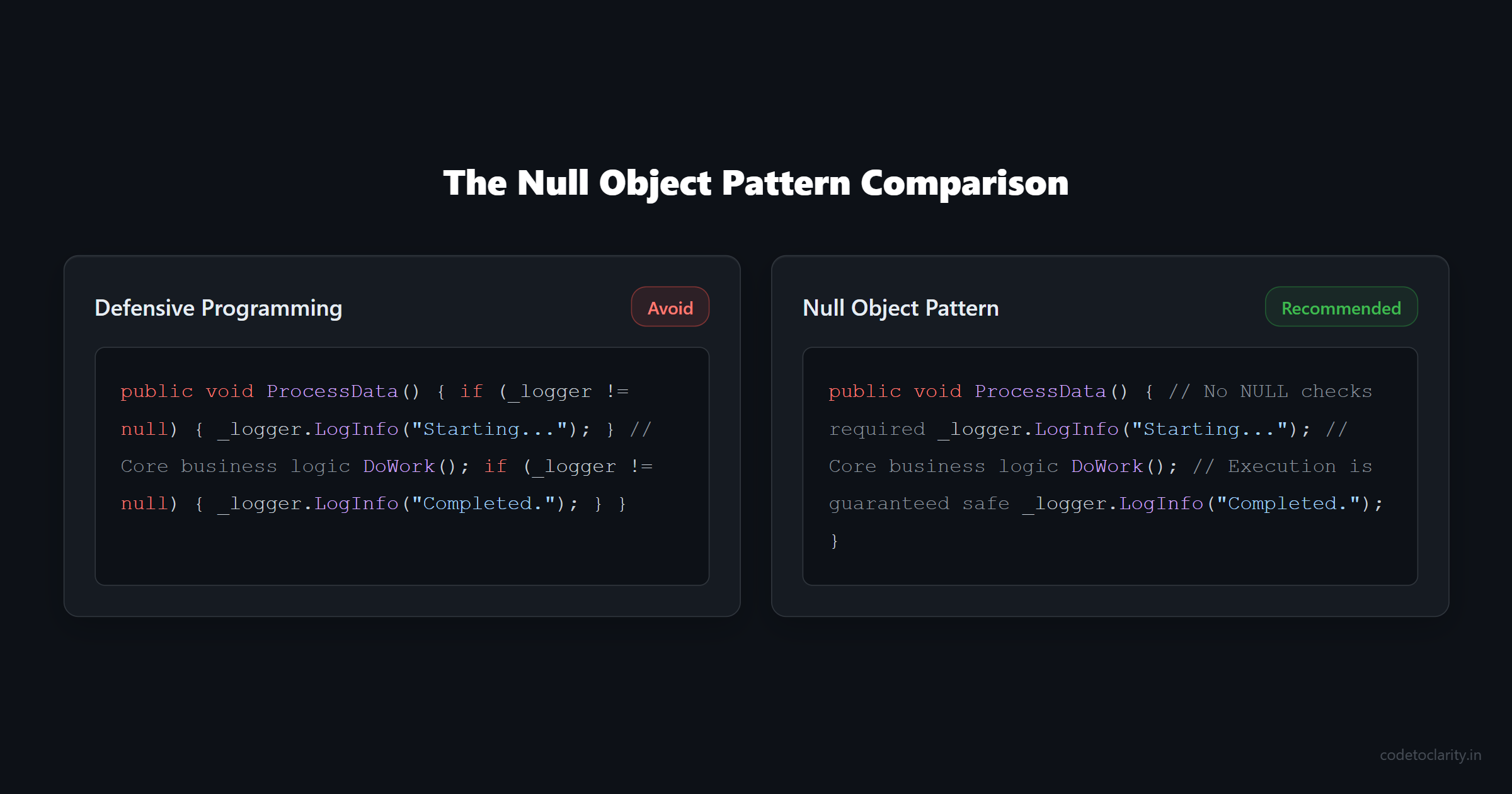
So, how do we fix this? The first strategy is a classic object oriented solution known as the Null Object Design Pattern.
The goal of this pattern is to provide an object as a surrogate for the lack of an object of a given type. This surrogate provides do nothing behavior, which allows the consuming code to treat it exactly like a real object without needing to perform NULL checks.
Let us look at a practical example. Imagine you are building a system that requires logging. You have an interface called ILogger and a concrete implementation called ConsoleLogger.
public interface ILogger
{
    void LogInfo(string message);
    void LogError(string message, Exception ex);
}

public class ConsoleLogger : ILogger
{
    public void LogInfo(string message)
    {
        Console.WriteLine($"[INFO]: {message}");
    }

    public void LogError(string message, Exception ex)
    {
        Console.WriteLine($"[ERROR]: {message} - {ex.Message}");
    }
}
Now, suppose you have a service that uses this logger.
public class CodeToClarityService
{
    private readonly ILogger _logger;

    public CodeToClarityService(ILogger logger)
    {
        _logger = logger;
    }

    public void ProcessData()
    {
        if (_logger != null)
        {
            _logger.LogInfo("Starting data processing.");
        }

        // Business logic goes here

        if (_logger != null)
        {
            _logger.LogInfo("Data processing completed.");
        }
    }
}
Notice the repetitive NULL checks throughout the service. In a testing environment, you might not want to log anything, so you might naturally pass NULL to the constructor. But this forces the service to constantly check for NULL to avoid crashing.
We can eliminate this problem entirely by creating a NullLogger that implements the ILogger interface but does absolutely nothing inside its methods.
public class NullLogger : ILogger
{
    public void LogInfo(string message)
    {
        // Do nothing
    }

    public void LogError(string message, Exception ex)
    {
        // Do nothing
    }
}
Now, we can update our service to require a valid ILogger instance. If the caller does not want logging, they simply pass the NullLogger instead of NULL.
public class CodeToClarityService
{
    private readonly ILogger _logger;

    public CodeToClarityService(ILogger logger)
    {
        // We ensure a valid object is provided
        _logger = logger ?? throw new ArgumentNullException(nameof(logger));
    }

    public void ProcessData()
    {
        // No more NULL checks needed!
        _logger.LogInfo("Starting data processing.");

        // Business logic goes here

        _logger.LogInfo("Data processing completed.");
    }
}
The code is now incredibly clean. The business logic is front and center, and the noisy checks are gone. The CodeToClarityService can confidently call methods on the _logger without worrying about application crashes. If you find design patterns fascinating and want to see other ways to clean up complex logic, you might also enjoy reading about the Strategy Pattern in C#.
Strategy 2: Optional and Nullable Types
While the Null Object Pattern is fantastic for behavioral dependencies, what do we do about missing data? What if a method searches a database for a user and legitimately cannot find one? Returning a Null User with empty properties might cause even more confusion in your application.
This is exactly where Optional types come into play. Many modern programming languages have recognized the billion dollar mistake and introduced features to explicitly represent the presence or absence of a value in a safe way.
In the .NET ecosystem, Microsoft introduced Nullable Reference Types in C# 8.0. This feature fundamentally changes how the compiler treats references. When enabled, all reference types are considered non nullable by default. If you declare a variable of type string, the compiler guarantees that it cannot be assigned NULL.
If you specifically need to represent a missing value, you must append a question mark to the type, making it string?. This tells the compiler that the value might be NULL. The compiler will then force you to check for NULL before accessing any properties on that object.
// With Nullable Reference Types enabled

public class UserService
{
    // The compiler knows this return type cannot be NULL
    public User GetDefaultUser()
    {
        return new User { Name = "Guest" };
    }

    // The question mark explicitly states this might return NULL
    public User? FindUserById(int id)
    {
        if (id <= 0)
        {
            return null;
        }

        return new User { Name = "CodeToClarity" };
    }
}
This brings the type system back into the equation where it belongs. It forces developers to be explicit about their intentions. If you try to use a nullable type without checking it first, you receive a compile time warning. This prevents the issue from ever reaching your production environment. You can read more about configuring these features in the official Microsoft documentation for Nullable Reference Types.
Other languages use a wrapper type called Optional or Option. Java introduced java.util.Optional, and C++ introduced std::optional. These wrappers force the developer to unpack the value safely, usually by providing a default fallback value or explicitly throwing a specific exception if the data is genuinely missing.
Strategy 3: The Fail Fast Principle
Sometimes, NULL values slip into your system from external sources that you do not control. An API request might have missing fields, or a database query might return unexpected corrupted results. In these scenarios, the best defense is to use the fail fast principle.
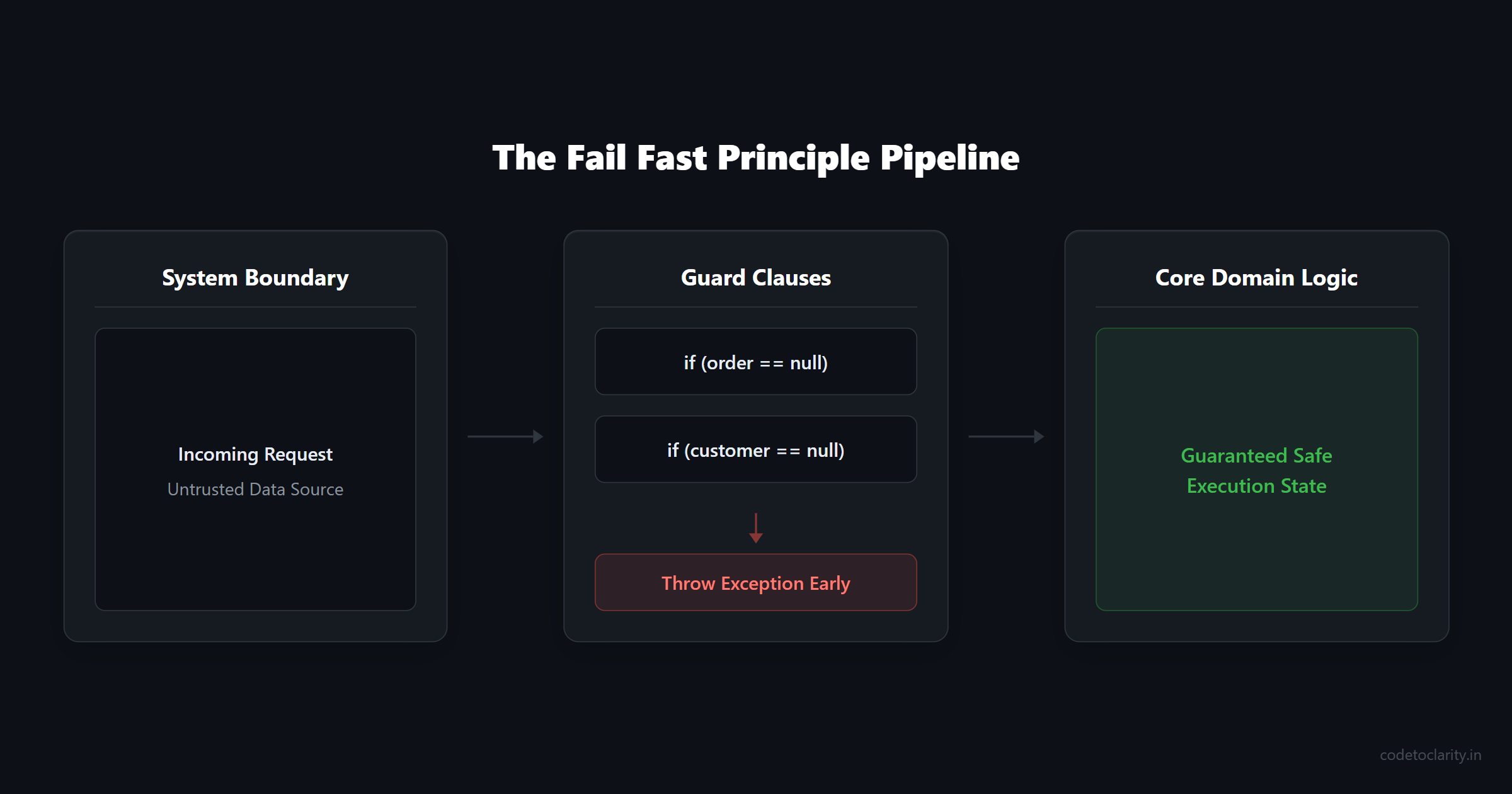
The idea is incredibly straightforward. Instead of allowing a NULL value to propagate deep into your application and cause a confusing crash later on, you should validate the inputs at the very boundaries of your system. If the data is invalid, you throw an exception immediately.
This technique makes heavy use of Guard Clauses. A Guard Clause is a check at the beginning of a method that verifies the incoming parameters before any real work begins. If the parameters are invalid, the method throws an exception right then and there.
public class OrderProcessor
{
    public void ProcessOrder(Order order, Customer customer)
    {
        // Guard clauses ensure data integrity early
        if (order == null)
        {
            throw new ArgumentNullException(nameof(order), "Order cannot be empty.");
        }

        if (customer == null)
        {
            throw new ArgumentNullException(nameof(customer), "Customer cannot be empty.");
        }

        if (string.IsNullOrWhiteSpace(customer.EmailAddress))
        {
            throw new ArgumentException("Customer email must be provided.", nameof(customer));
        }

        // Safe business logic safely executes below
        CodeToClarity.SendConfirmation(customer.EmailAddress, order);
    }
}
By failing fast, you make the debugging process significantly easier for everyone on your team. The exception stack trace points directly to the exact point of entry where the invalid data was received. You no longer have to trace a null value backwards through ten layers of architecture. It prevents your system from entering an unpredictable state.
For standardizing how you validate complex objects across your entire application, tools like FluentValidation are incredibly powerful. You can read our complete guide on how to use FluentValidation in ASP.NET Core to see how to implement clean and reusable validation rules that keep your code pristine.
Strategy 4: Looking at Modern Languages Without NULL
If we look at the evolution of programming languages over the last decade, we can see a clear trend moving entirely away from NULL. Many modern and highly regarded languages have completely eliminated the concept of a null reference from their foundational design.
Rust is a prime example of this movement. Rust is beloved by developers specifically for its strict safety guarantees and memory management. Instead of relying on NULL to represent missing data, Rust provides a native enumeration called Option<T>.
The Option type is simple. It can have two specific variants. It can be Some(value) which contains the actual underlying data, or it can be None which represents the total absence of data.
Because Option is an enumeration, the Rust compiler forces the developer to handle both possibilities using pattern matching. You absolutely cannot accidentally use an Option as if it were the underlying value. You are forced to explicitly unwrap it every single time.
// A simple Rust example demonstrating the Option type
fn find_user(id: i32) -> Option<String> {
    if id == 1 {
        Some(String::from("CodeToClarity"))
    } else {
        None
    }
}

fn main() {
    let result = find_user(1);

    // The compiler forces us to handle both Some and None branches
    match result {
        Some(name) => println!("User found: {}", name),
        None => println!("No user found in the system."),
    }
}
This design makes it mathematically impossible to have a NullReferenceException in safe Rust code. The intent of the developer is perfectly clear, and the compiler serves as an uncompromising guardian of system stability. You can explore this concept deeply by reading the official Rust documentation for Option.
Other highly reliable functional languages like Haskell and Elm use similar Algebraic Data Types to handle missing values gracefully. Even mainstream languages like Swift and Kotlin have built their type systems around non nullable types by default. They require explicit syntax to indicate optionality. The consensus across the software engineering industry is clear. The era of the unchecked null reference is finally coming to an end.
Re-Engineering Your Approach to Missing Data
We have covered a massive amount of ground in this article. We have seen how a simple implementation decision made in 1965 cascaded into billions of dollars of lost productivity and disastrous software failures. We have explored how NULL obscures intent, pollutes code with defensive checks, and causes frustrating runtime explosions.
More importantly, we have looked at concrete and actionable ways to fix the problem in your own projects.
- Use the Null Object Pattern to provide safe and default behavior for your service dependencies instead of passing NULL around your architecture.
- Leverage Nullable Reference Types or Optional wrappers to make missing values an explicit and strictly typed part of your domain models.
- Apply the Fail Fast Principle using guard clauses to stop invalid data at the boundaries of your system long before it causes damage deep inside your logic.
- Learn from modern languages that prioritize safety through compiler design and pattern matching.
Writing robust software is fundamentally about minimizing unexpected states. Every single time you type the word NULL into your editor, you are introducing a tiny element of chaos into your application. By adopting these modern strategies, you can write cleaner, safer, and much more intention revealing code. Your future self, and the developers who maintain your code years from now, will absolutely thank you.
If you are looking to further modernize your software engineering skills and write cleaner code, taking the time to master these concepts is a powerful step forward. Stop letting NULL dictate your application architecture, and start taking absolute control of your data flow today.

Kishan Kumar
Software Engineer / Tech Blogger
A passionate software engineer with experience in building scalable web applications and sharing knowledge through technical writing. Dedicated to continuous learning and community contribution.